

Story Preview
Ezra sat on his apartment building's roof, watching pigeons circle the brick chimneys. He liked roofs. They were quiet. They asked nothing of him. Then his foot caught something hard wedged between two tiles. A brass compass, dulled by weather, its face still bright enough to read. He picked it up. The needle trembled. No child can ignore a found thing, and Ezra was no exception. He turned the compass slowly in his hands. The needle followed. North, south, east, west—it obeyed like a dutiful finger.
That night, alone in his room, Ezra studied the compass under lamplight. The numbers around its edge were normal. The markings were ordinary. But when he stopped spinning it, something strange happened. The needle quivered once. Then it locked—not north, but northeast, toward a part of the city he'd never visited. His stomach tightened. He turned. The needle corrected itself, pulling the same direction again. “It's broken,” he whispered. But broken things sometimes point truer than whole ones.
Dawn found him on the fire escape, compass in one pocket, his jacket zipped against the September cold. Each step down the metal stairs rang like a bell. The city woke around him—car horns, voices, the rumble of a distant train. He clutched the compass. The needle pointed northeast, steady as a promise. Ezra had spent so long in quiet rooms that the street felt enormous and bright. But the needle didn't care. It pulled. So he walked.
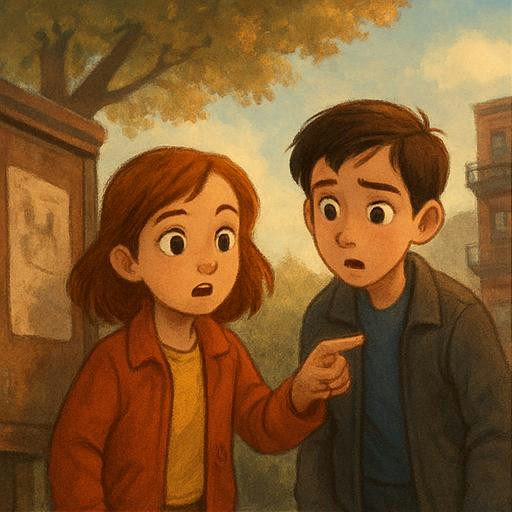
“Where are you going so fast?” Mara stepped out from behind a newspaper stand, her dark hair tangled from sleep. She lived in his building—third floor, he thought. He'd seen her maybe three times. “Walking,” Ezra said, which was technically true. “With that thing?” She pointed at the compass. “What is it?” “A map.” Mara grinned. “Then I'm coming. I've been waiting for someone else to leave this block.”
They moved through the city's shoulder for an hour, following the compass deeper into neighborhoods Ezra had only imagined. Past a park where an old man sat alone on a bench, staring at nothing. Ezra almost stopped. But Mara was ahead of him now, marching like a general. “Come on,” she called. The compass needle pulled harder. Ezra glanced back at the old man once. He didn't move. Something in his stillness made Ezra's chest feel small and tight.
“It's pointing to treasure,” Mara said, breathless. “That's the only explanation. Some buried thing, or hidden money, or—” “A map doesn't work like a metal detector,” Ezra began, but he didn't actually know what the compass did. Neither of them did. “Maybe it does,” Mara said. “Maybe it's magic.” Ezra thought about the needle's pull, how it never wavered. Magic. The word fit like a key in a lock. If treasure didn't exist, he could go home. If it did, he'd found it first.
The compass led them to a library with tall windows and a blue-painted door. The needle stopped pulling as soon as they crossed the threshold. Mara deflated like a popped balloon. “This can't be right.” But Ezra saw it first: a notice pinned to the bulletin board. A photograph. A golden dog with one ear folded. Below it, three words in careful handwriting: HAVE YOU SEEN BISCUIT? “That's not treasure,” Mara whispered. “No,” Ezra said. “It's something else.”
Mara's face changed. “I know that dog. Her name is Sophie—the girl who owns him. She sits two rows back in my class. She was crying yesterday.” Ezra held the compass. The needle was still, no longer pointing. It had gotten them here. To the notice. To a lost thing. To a girl who was crying. “The compass knew,” Mara said quietly. Ezra wasn't sure what it knew, or how, or why. But he was beginning to understand: treasure wasn't something you found. It was something you returned.
They searched the city for three days. The compass hung useless in Ezra's pocket now, its needle still and ordinary. They knocked on doors. They posted new notices. They asked everyone: Have you seen Biscuit? Most people shook their heads. A few said maybe, once, near the water. But no Biscuit. No golden dog with a folded ear. Ezra began to understand what Mara had always known: the hardest treasure to find is the one that's truly lost.
On the third afternoon, they passed through the park again. The old man was still on his bench, still staring. This time, Ezra didn't walk past. “Have you seen a golden dog?” he asked. The old man looked up. “The one that hides by the creek? Comes through here dawn and dusk. Scared of people. Won't let anyone near.” Ezra's breath caught. “He's seen Biscuit,” he told Mara. And the old man, in his loneliness, had noticed something everyone else missed. In helping him, they'd been helped in return.
The creek ran through the park's far corner, where trees grew thick and wild. Ezra moved slowly, listening. Mara stayed behind him. Then he saw the flash of gold. Low to the ground. A shape curled beneath a fallen log, trembling. Biscuit. Thin. Afraid. Eyes like dark stones. Ezra crouched down. Didn't move closer. Mara had brought food and water. He set the bowl down gently and backed away. “It's okay,” he whispered. “We're not going to hurt you. You're going home.”
It took an hour. Mara sat beside Ezra in the dirt, and they waited while Biscuit ate. Slowly, the shaking stopped. The dog's eyes softened. He sniffed Ezra's hand. Then—a miracle small enough to fit in a boy's palm—Biscuit let himself be touched. Lifted. Carried. Ezra felt the dog's heartbeat against his chest, quick and warm. Bravery wasn't running forward into danger. It was this: holding something scared and making it safe.
Sophie's mother opened the door. When she saw Biscuit, she made a sound like breaking glass. Sophie herself cried so hard she couldn't speak, just held the dog and held him. “Where did you find him?” the mother asked, her voice shaking. “In the park,” Mara said. “By the creek.” The mother hugged them both. Sophie did too, Biscuit squished between them. Ezra had never felt anything like that hug—the weight of being needed, the warmth of mattering. That night, he understood: this was what the compass had been pointing toward all along.
Ezra held the compass in his palm. The needle was still now, perfectly still. It pointed neither north nor south. Neither east nor west. Just still. He thought about the old man on the bench. About Mara waiting beside him. About Biscuit's heartbeat and Sophie's tears. The compass hadn't shown him a map. It had shown him something better: the path to people who needed him. The real magic wasn't in the needle. It was in following it with his whole heart.
Ezra slid the compass into his pocket. It rested there, quiet and warm, like something that had finally found home. “What now?” Mara asked from his doorway. He thought about the old man still sitting on his bench. He thought about the park's dark corners and quiet places where lost things hide. He thought about roofs and quiet rooms—and how they'd always be there if he needed them. But today, he didn't need them. “Now,” Ezra said, smiling at Mara, “we go back to the park.”