
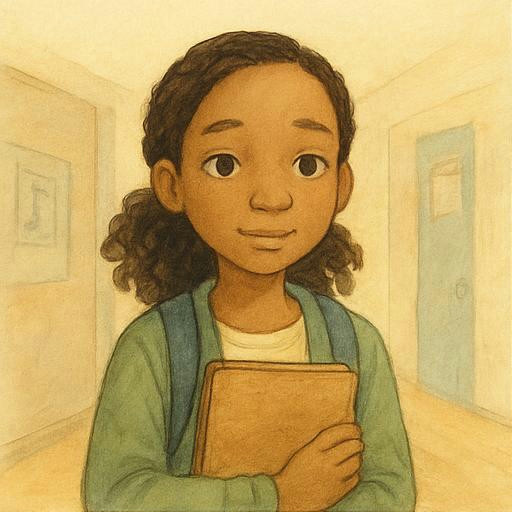

Story Preview
Jayla was having an ordinary Tuesday when her ordinary day exploded. Marcus Chen threw a basketball directly at her face. It bounced off her forehead with a soft thump. In any other universe, she would have cried or thrown it back. Instead, her eyes blinked twice—once, twice—and she was asleep before she hit the ground. When she woke up, Ms. Chen was standing over her with a concerned frown.
This had happened fourteen times this school year. Fourteen times. Jayla had a condition so rare that only a handful of doctors in the world had ever heard of it. Triggered by shock or overstimulation, her brain simply shut down. Like a light switch. Off. Sleep. Done. Most kids might call it a superpower. Most kids were liars. What they actually called it was weird. What they actually did was laugh—or worse, avoid her altogether, as though her sleep might be contagious.
“You okay, Jayla?” asked Emma, her only friend, during lunch. Emma asked this every time now, which meant she was still there, which meant something. “Fine,” Jayla said, not fine. She poked at her applesauce with a spoon. “It's not contagious, you know.” Emma smiled. It was the kind of smile that said she already knew that, and also that she didn't care. Those were the best kind of friends.
That afternoon in the library, Jayla found a book with a cracked spine and a title in gold letters: The Neuroscience of Sleep. It was far too advanced for her age. She read it anyway. Words swam across the pages—cortisol, REM cycles, parasympathetic responses—and slowly, something shifted in her chest. The book didn't treat sleep as a punishment. It treated it as a system. A system meant something. Systems could be understood. Maybe even fixed.
She began watching herself like a scientist watches an experiment. Every time she shocked awake—literally, sometimes, from loud noises—Jayla wrote down what happened first. What time. What triggered it. How she felt before the darkness took her. Her notebook grew thick with observations. Heart racing. Breath short. A tingling in her fingers. Always the same pattern. Always the same, until it wasn't.
One morning, someone knocked on her classroom door. A substitute teacher appeared, and behind her stood a girl with purple sneakers and a backpack covered in patches. “This is your new classmate,” the substitute announced. “Her name is Priya. She's joining us from the city.” Priya looked directly at Jayla and smiled like they were already friends. They weren't. But the morning was unusually quiet. Nobody threw anything.
At recess, Priya found her. “Why do people treat you like you're contagious?” she asked immediately. Jayla braced for the usual script: pity, curiosity, the questions she'd answered a thousand times. Instead, Priya said, “I have migraines that make me throw up without warning. People think that's gross. Want to compare notes?” And just like that, Jayla wasn't alone in the weird-kid category anymore. They were weird together.
With Priya, something unexpected happened. She didn't avoid surprising moments. She created them. She'd tap Jayla's shoulder hard from behind. She'd play loud music. She'd shout her jokes. Each time, Jayla felt the familiar approach of sleep, but Priya would catch her—guide her to a safe spot on the grass, sit beside her, and read aloud from her comics while she slept. “You're safe,” she'd say when Jayla woke. That word—safe—became important.
One afternoon, Jayla made an observation that stopped her cold. In her notebook, the data was clear: she only fell asleep if the shock was unexpected. When she knew something was coming—when she was prepared, when Priya gave her a warning—her body didn't shut down. Her heart didn't race. The system didn't trigger. She could feel the overstimulation, manage it, stay awake. Expectation. That was the variable. Nobody had ever told her that.
“You're basically already a doctor,” Priya said when Jayla showed her the notebook. “You diagnosed yourself.” But Jayla was thinking bigger. She was thinking: if she could understand her own condition, really understand it, could she help someone else understand it too? Could she be the kind of doctor who listened to kids with rare illnesses? Could she build tools to help them? The idea bloomed in her chest, warm and bright. It felt like the opposite of falling asleep.
The hard part came next. She needed data. Real data. She asked Dr. Patel, the school nurse, if she could design a tiny experiment. Something small. Something safe. Something that tested her theory. Dr. Patel listened to Jayla's idea, read through her careful notes, and said yes. Not maybe. Yes. They set it up in a quiet corner of the nurse's office: Jayla would prepare for small surprises, and measure her body's response each time.
Over two weeks, something remarkable happened. The data confirmed her theory. With warning, her system stayed calm. Without it, the shutdown triggered. Dr. Patel leaned back in her chair and looked at Jayla with an expression that changed everything. “Do you understand what this means?” she asked quietly. “You've just mapped something about your condition that medical literature doesn't fully explain yet. You did this. You, Jayla, at age eight. You're going to be extraordinary.”
Word got out. Teachers mentioned it to other teachers. Parents heard at pickup. Suddenly, the girl who fell asleep unexpectedly wasn't weird anymore—she was the girl who understood her own illness. Marcus Chen avoided her eyes in the hallway. Jayla didn't feel triumphant about that. She felt something else: purposeful. She had work to do. Real work. A future mapped out like her data points, each one connected to the next.
Priya found her after school with that familiar grin. “So what's next, Doctor Jayla?” she asked. Jayla looked at her notebook—pages filled with careful observations, sketches of her heart rate, notes about the future. “I want to figure out if other kids with rare conditions have things that help them too. Things nobody knows about yet.” She paused. “And maybe one day, I'll make medicine that helps people like me. Medicine that actually works.”
That evening, sitting on her bed with her notebook open, Jayla realized something had shifted. She was still the girl with the one-in-800-million condition. She would probably always fall asleep when the world surprised her. But now, she wasn't the girl who was broken. She was the girl who paid attention—who noticed patterns everyone else missed, who asked questions, who turned her weakness into a map. And maps, unlike the dark of sleep, always pointed somewhere.