

Story Preview
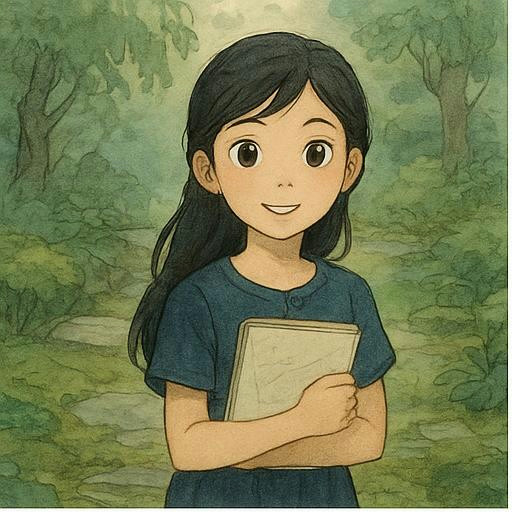
Ruka knelt by the stone pond every morning, before breakfast, before school, before anything else mattered. The water was dark and cool, and in it swam seven koi fish in shades of gold, white, and rust-red. Her favorite was named Hikari—the Bright One—because a stripe of luminous gold ran down her spine like a river of light. “Hello, old friend,” Ruka whispered. Hikari rose to the surface, her mouth making a small O, as if she were telling secrets. Ruka felt it then: a flutter in her chest, a longing as deep as the pond itself. She wanted to know what Hikari saw. She wanted to understand.
Ruka's grandmother lived in a house of worn wood and creaking floors, surrounded by gardens that rambled like a storybook. Jasmine vines climbed the fence. Stones wore moss like velvet. In the back corner sat the pond—six paces wide, dark with ancient water, and home to seven generations of koi, according to Grandmother. “The pond remembers,” Grandmother said mysteriously, though she never explained what it remembered. Every afternoon when Ruka came home from school, she rushed to the water's edge with a handful of koi food. The fish scattered and swirled. She counted them: one, two, three... seven. All still there. All still alive.
One evening, something strange happened. The garden grew quieter. Even the cicadas paused their song. Ruka sat on the mossy stones, sketching Hikari in her notebook—the curve of her fins, the determined angle of her jaw. A breeze moved across the water, but it was a warm breeze, almost breath-like. The water rippled and shimmered. In the center of the pond, something glowed. Not a light, exactly. More like the water itself had remembered how to shine. Ruka set down her pencil. She leaned closer. The glow brightened, and in its heart, she saw something like a mirror—a surface that reflected not her face, but her *feeling*: the wild wish to swim, to see the world from Hikari's eyes, to belong to the water.
“Ruka!” Grandmother called from inside the house. “Dinner!” But Ruka couldn't move. The glow pulled at her like a current. Just one wish, she thought. Just one. She whispered to Hikari, “What is it like? What do you see down there?” The golden mirror blazed. Ruka reached toward it. Her hand broke the surface. The water was warm—warm like blood, warm like breath. She wanted to pull back. She should have pulled back. But the warmth wrapped around her wrist, her forearm, her elbow. It didn't hurt. It felt like coming home.
Everything went silver and blue. Her body felt different—lighter, streamlined, *slippery*. She looked down at her arms and gasped. Where hands had been, fins now flickered. Where skin had been, scales caught the light like coins. She opened her mouth to scream, but bubbles came out instead. *What happened?* *What did I—* And then she understood: she was underwater. She was *in* the pond. She was—she spun in the water, dizzy and terrified—she was a fish. A koi. Like Hikari. “This isn't real,” she thought. “This is a dream. I'll wake up.” But the water tasted like minerals and moss. The sensation was absolutely, impossibly real.
She sank deeper. The pond suddenly seemed vast—not six paces wide, but an entire ocean. Above, the surface rippled with the last light of evening, wavering and strange. Below, the bottom was soft and dark, scattered with smooth stones and the skeletal arms of submerged plants. And everywhere—*everywhere*—she saw things she had never noticed from the surface. A tiny red newt darting between stones. Insects suspended in the water like floating gems. A shaft of filtered sunlight that turned everything golden and ethereal. The world was full of creatures and colors and secrets. She hadn't known. She had spent every morning watching, and she had seen nothing. How could Hikari keep all this wonder to herself?
“You came,” a voice said. Ruka spun. Hikari floated before her, calm and patient, as if a girl turning into a koi happened every Thursday. “How did I—” Ruka's fish-voice came out strange and musical, like wind chimes. “The pond grants wishes sometimes,” Hikari said. “Not often. Not to everyone. But those who love truly enough... the pond listens.” Ruka wanted to ask: How do I change back? What if I'm stuck? Why didn't you warn me? But instead she asked: “What's that?” She was pointing at a glimmer of something pale, wedged beneath a stone on the pond floor, far below where they floated.
“That?” Hikari's eyes narrowed. “I've never seen that before. And I've been in this pond for six years.” Together they dove. The water grew colder as they descended. Ruka's fish-body moved with surprising grace—she flicked her tail and *glided*, understanding suddenly how fins worked, how the water could hold her weight. The pale thing grew clearer: a small object, rectangular, with strange markings. As she drew near, she realized what it was. A mirror. A tiny hand mirror, tarnished silver, with an ornate handle carved from something that looked like jade. “It's beautiful,” Ruka breathed. “And it shouldn't be here.” Hikari didn't answer. She stared at the mirror as if it might bite.
Ruka reached for it. Her fin-hand passed through the handle. It was stuck—caught somehow, wedged between the stone and mud. She pulled harder. The mirror shifted. Suddenly, silt exploded upward in a dark cloud, and the pond water became murky and strange. Through the haze, Ruka heard Hikari cry out: “The Mirror! It's waking it!” “Waking what?” Ruka called. But her friend was already swimming away, toward the light above. The silt continued to rise like smoke. And beneath it—in the deepest, darkest part of the pond—something moved.
Ruka froze. The movement was large. It was old. The water around her grew cold, then colder still. She wanted to follow Hikari to the surface, to light, to safety. But her eyes—koi eyes, good in the darkness—saw something that made her stop. In the settling silt, a shape emerged. Not a monster. Not a creature at all. Another koi. Enormous. Ancient. Its scales were dull and worn, and its color had faded to gray. One of its eyes was clouded white. It floated motionless at the bottom of the pond, and Ruka understood with sudden clarity: this koi was dying. Or dead. Or something in between. And the mirror—the mirror beneath its stone had been keeping it in the dark, hidden, *safe*.
“I'm sorry,” Ruka whispered. “I didn't know.” The old koi's remaining eye—the clear one—fixed on her. It blinked slowly. And in that blink, Ruka felt something extraordinary: not words, but *knowing*. The old koi had been in this pond longer than anyone. She had lived through gardens that had changed, seasons that had cycled countless times. She had been the first, the founder, the one from whom Hikari and all the others had descended. And when she grew too old, too tired, she had chosen to rest at the bottom, in darkness, where the mirror could guard her from being seen, being bothered, being remembered as anything but powerful. “You're the first,” Ruka said. “The one Grandmother spoke about.”
The old koi did not move, but something shifted in her clouded eye. Understanding passed between them—fish-to-fish, girl-to-ancient-one, mortal-to-something-else. “I thought I wanted to see what you saw,” Ruka said slowly. “But you were seeing something different all along. You were seeing *time*.” She looked around the pond with new eyes. Every stone, every plant, every shadow held history. The water itself was a living record. This wasn't just a garden pond. It was a world. And she had been allowed to enter it—not to play, not to adventure, but to *understand*. To see that some creatures needed to be left alone. To learn that watching wasn't enough. Sometimes you had to see what lay beneath.
Ruka did something she hadn't planned. She pushed the mirror deeper into the mud, covering it carefully with silt and soft stone. “Your secret is safe,” she said to the old one. “I won't tell.” Then she turned and swam upward, toward the fading light. The water warmed as she rose. Hikari appeared above her, waiting. “You understand now,” the golden koi said. It wasn't a question. “Yes,” Ruka said. And then, suddenly, she felt a pulling sensation—not urgent or frightening, but gentle, like a hand reaching down to help her up. The water grew bright. Her gills became strange. Her fins began to ache and reshape themselves back into limbs. She was rising. Changing. Going home.
Ruka gasped and broke the surface, coughing water. She was kneeling on the mossy stones, soaked and shivering, her clothes dripping, her hair plastered to her face. The evening had turned to dusk. A single star burned overhead. Her hands—human hands, with fingers—shook as she held them up to the fading light. Had it been a dream? But no—she could taste the pond water on her lips. She could still feel, deep in her bones, the memory of swimming. The sense of time and secret things. She looked at Hikari, floating at the surface, regarding her with ancient understanding. Ruka smiled. She understood now what her grandmother had meant: the pond *did* remember. And so would she.
That night at dinner, Ruka was quiet. Her grandmother studied her face across the table. “You've been swimming,” she said with a knowing smile. “How did you know?” Ruka asked. “Your hair. It has that look—like it's remembered something.” Grandmother set down her chopsticks. “The pond grants wishes carefully. Not to make us happy. To make us wise.” Ruka didn't ask what her grandmother had wished for when she was young. Some secrets belonged to the pond, and to time, and to the patience of things that had seen the world change and change again. She simply nodded. The next morning, before breakfast, before school, she knelt by the water and watched Hikari rise to feed. The golden koi looked at her differently now—like a friend who had seen her true self and chosen to keep her anyway.