

Story Preview
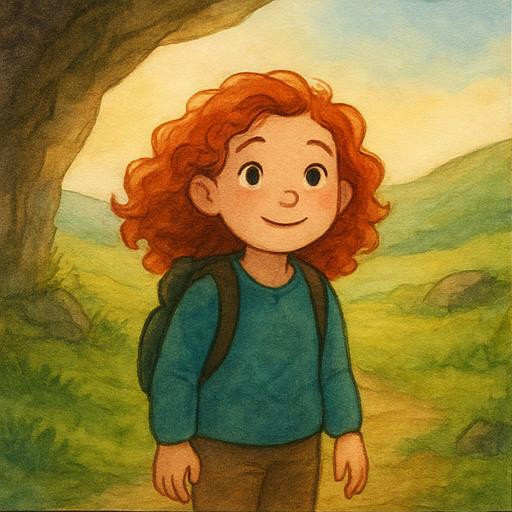
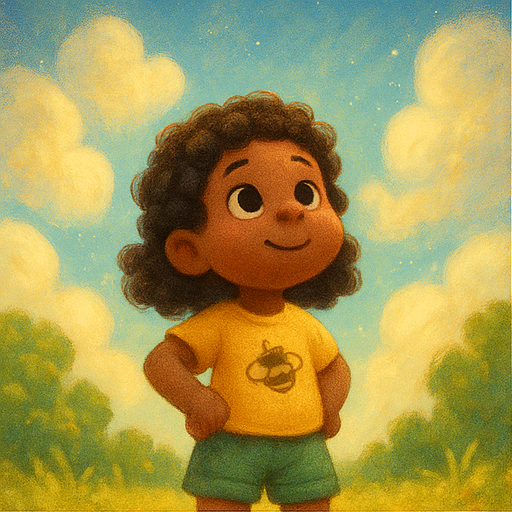
Elsie sat cross-legged in her garden, watching a butterfly dance from flower to flower. She loved spending quiet mornings here, surrounded by the sweet smell of roses and the gentle buzz of bees. As she reached for her watering can, something caught her eye. A tiny brown shell, no bigger than her thumbnail, was stuck to the side of a flowerpot. "Oh!" Elsie gasped softly. "A little snail!" She leaned closer, her brown curls falling forward. The snail's head poked out slowly, revealing two pairs of tentacles. The longer ones had tiny black dots at the tips. "Are those... eyes?" Elsie wondered aloud.
The snail moved its tentacles gently, as if waving hello. Elsie watched, fascinated, as it began to glide across the pot. "How are you moving without any feet?" she asked. A silvery trail appeared behind the snail as it traveled. Elsie touched the trail carefully with her finger. It felt slippery and cool. "Is this how you slide along?" She noticed the snail seemed to be heading toward the shadowy area under a large leaf. "Are you looking for somewhere cooler?" The morning sun was getting warmer, and Elsie realized the flowerpot must feel quite hot. She had so many questions bubbling up inside her.
"I'm going to learn all about you," Elsie declared to her new friend. She ran inside and grabbed her notebook with the sunflower on the cover. Back in the garden, she carefully moved the snail to a shady spot on a broad hosta leaf. "There, that's better!" She opened her notebook and wrote: 'Snail Questions: How do they move? What do they eat? Why do they have shells?' She watched as the snail began exploring its new leaf. "Maybe you eat leaves?" Elsie guessed. She picked a tender lettuce leaf from the vegetable patch and placed it near the snail. "Here's a yummy lunch!"
But the snail didn't seem interested in the lettuce at all. It continued its slow journey across the hosta leaf. Elsie frowned thoughtfully. "Hmm, maybe you don't like lettuce." She gathered different leaves - spinach, cabbage, even a rose petal. She arranged them like a tiny salad buffet around the snail. "Surely you'll like one of these!" she said hopefully. Hours passed. The snail investigated each offering with its tentacles but didn't stop to eat any of them. Elsie's stomach rumbled. "Well, I'M hungry even if you're not," she laughed. She was learning that science took patience.
After lunch, Elsie returned with more determination. She brought a magnifying glass this time. "Let's look more closely," she said, peering at the snail through the lens. "Wow! Your shell has beautiful spiral lines!" She noticed the snail had finally moved to a different plant - one with small holes in its leaves. "Wait a minute..." Elsie examined the leaf edges. They looked scraped, not bitten. She checked other plants nearby. Many had these scraped patches and tiny holes. "Did YOU make these marks?" she asked excitedly. The snail, of course, didn't answer, but Elsie felt like she was onto something important.
"Maybe you don't bite food like I do," Elsie reasoned. "Maybe you... scrape it?" She remembered learning about different animals' teeth in school. "But you're so small. Do you even have teeth?" She spent the afternoon trying to see the snail eat, but it seemed to prefer traveling to dining. By evening, Elsie was puzzled. She'd offered the snail everything she could think of, but nothing seemed right. "Don't you ever get hungry?" she asked. As the sun set, she carefully created a small habitat for the snail in an old terrarium, adding soil, leaves, and a shallow dish of water. "I'll figure out your secrets tomorrow," she promised.
The next morning brought a surprise. Many of the leaves in the terrarium had new scrape marks! Elsie clapped her hands. "You DID eat! But when?" She realized she'd been watching during the day, but maybe... "Do you eat at night?" she wondered. She examined the scraped areas with her magnifying glass. The marks looked like tiny rows, almost like someone had used a miniature grater. "How do you make these marks?" She decided to ask her mom if she could stay up a little late to watch. Her mom smiled. "A nighttime science observation? How exciting! But only until 9 o'clock." Elsie hugged her mom. Tonight, she'd solve the mystery!
That evening, Elsie sat by the terrarium with a small flashlight covered in red paper (she'd read that red light didn't bother nighttime animals as much). At first, nothing happened. Then, slowly, the snail emerged from under a piece of bark. It glided to a fresh lettuce leaf and... began to eat! "Oh my goodness!" Elsie whispered. Through her magnifying glass, she could see something incredible. The snail had a ribbon-like tongue that moved back and forth against the leaf. "It's like a tiny cheese grater!" she realized. "You're rasping the leaf!" She grabbed her notebook and started sketching what she saw.
Over the next few days, Elsie made more discoveries. She learned that snails loved cucumber slices and soft fruits. She noticed they were most active when she misted the terrarium with water. "You like it damp, don't you?" One morning, she found the snail had climbed all the way up the glass wall. "How did you stick up there?" She watched carefully and saw that the snail made its own slime path that helped it grip surfaces. "That's amazing! You make your own glue!" She also noticed the snail would pull into its shell whenever she moved too quickly. "You're shy, just like my little sister," she said gently.
Elsie started keeping a snail journal. She drew pictures and wrote observations: 'Snails can smell with their lower tentacles! The upper ones have eyes that see light and dark. They breathe through a hole in their side called a pneumostome.' She felt like a real scientist. One day, she noticed something odd. There were tiny, pearl-like spheres in the soil. "What are these?" She carefully scooped one up. It was no bigger than a pinhead, white and perfectly round. Her heart raced with excitement. Could these be... eggs? She counted them carefully. "Twelve tiny eggs! But wait... I only have one snail. How did this happen?"
Elsie rushed to the library with her mom. They found a big book about garden creatures. Elsie flipped to the snail section and read eagerly. "Mom, listen to this! It says snails are hermaphrodites. They can be both male and female!" Her mom helped her understand the big word. "So my snail could lay eggs all by itself?" Elsie was amazed. The book also explained that snails could live for several years and that their shells grew with them, adding new spirals. "That's why the shell has those lines - like tree rings!" Elsie exclaimed. She felt like she'd uncovered treasure. Every answer led to new wonders about her small friend.
Back home, Elsie watched the eggs carefully. After two weeks, she saw movement. "They're hatching!" Tiny snails, no bigger than grains of sand, emerged. Their shells were transparent, like delicate glass. Elsie could barely breathe from excitement. "Look at you all! So perfect and small!" She counted twelve baby snails, each making its own miniature slime trail. She realized how much she'd learned - about what snails eat, when they're active, how they move, and now, how they have babies. "You taught me so much," she told the parent snail. "And all I had to do was pay attention and be patient."
Elsie understood now that every creature, no matter how small, had amazing abilities. Snails could climb walls, see without true eyes, eat with thousands of tiny teeth, and even have babies on their own. They recycled plant matter and helped the garden stay healthy. "You're not just a snail," she said. "You're an engineer, a climber, a recycler, and a parent!" She realized that learning wasn't about getting quick answers. It was about watching, wondering, trying different ideas, and being patient enough to let the answers reveal themselves. Sometimes the best discoveries came from simply sitting still and observing. Her small snail had taught her one of science's biggest lessons.
Elsie decided to create a snail observation station in her garden. She painted a sign that read 'Snail Study Zone' and set up several shallow dishes with different vegetables. She made a chart to record which foods different snails preferred. "Now I can help other kids learn about snails too!" she said proudly. Her little sister Sophie joined her one morning. "Why do you like these slimy things?" Sophie asked, wrinkling her nose. Elsie smiled. "Watch this," she said, placing a snail on a clear piece of plastic. They looked from below as the snail moved. "See those waves moving along its foot? That's how it walks!" Sophie's eyes widened. "Cool!"
Word spread about Elsie's snail station. Soon, neighborhood kids were bringing lettuce leaves and watching in wonder as snails performed their slow-motion acrobatics. Elsie taught them about the radula (the ribbon tongue), the pneumostome (the breathing hole), and how snails help gardens by breaking down dead plants. "Every tiny creature has something to teach us," Elsie explained. "We just have to take time to look." She carefully released most of the baby snails into different parts of the garden, keeping just a few for observation. As she watched them spread out into their new world, she felt proud. She'd started with one question - 'Are those eyes?' - and discovered a whole universe of answers. Sometimes the smallest teachers taught the biggest lessons.