

Story Preview
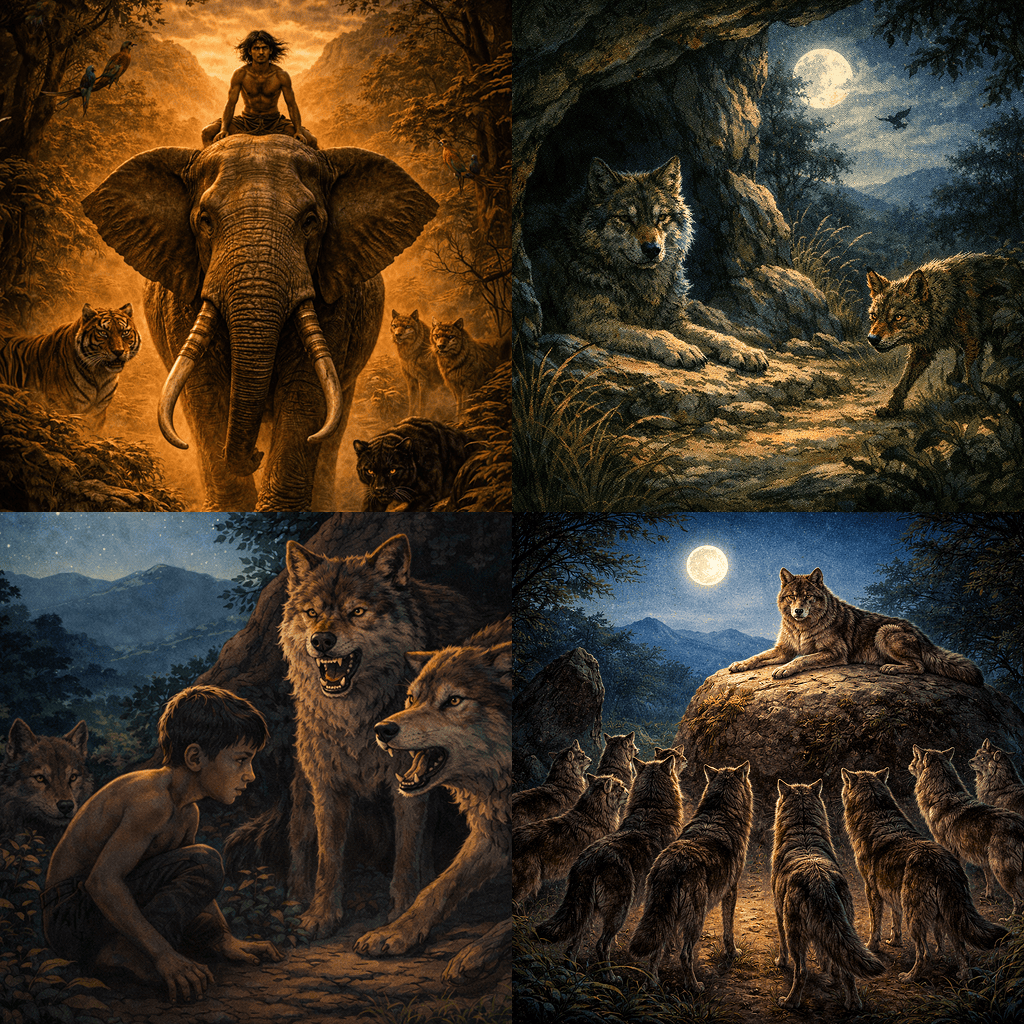
On a warm evening in the Seeonee hills, Father Wolf woke up, yawned, and stretched his paws one by one. Mother Wolf lay beside him, her grey muzzle resting on four tumbling, squealing cubs. The moon shone into the mouth of the cave. Suddenly a small shadow with a bushy tail appeared at the entrance. It was Tabaqui the Jackal — a creature the jungle both despised and feared. He slunk everywhere, spreading gossip and scrounging scraps from village rubbish heaps. But when Tabaqui went mad — and it happened — even the tiger would run away. After crunching a bone he had found in the corner, the jackal mentioned as if in passing: Shere Khan, the great tiger of the Waingunga River, had decided to hunt in these hills. Father Wolf was furious — by the Law of the Jungle no one may change hunting grounds without warning. Mother Wolf shook her head quietly: lame Shere Khan had frightened away the people in his own territory, and now he would bring trouble here. When Tabaqui slipped away, a roar rose from the valley below. The tiger was hunting. But then the roar turned into an angry howl — Shere Khan had leapt at a woodcutter's campfire and burned his paws. In the night silence, something rustled in the bushes and began climbing straight toward the cave.
Father Wolf crouched ready to spring — then froze. Directly before him, clinging to a low branch, stood a small naked child. Plump, brown, barely old enough to walk. He looked up at the wolf — and laughed. Father Wolf took the baby gently in his jaws — so carefully that not one tooth touched the skin — and laid him among the cubs. Mother Wolf bent her head: the man-cub was pushing fearlessly between the pups, seeking warmth. "Mowgli — the Frog," she said softly. "That is what I shall call you." But then the moonlight in the cave went dark. Shere Khan's great square head was thrust into the narrow entrance. The tiger demanded the child — he considered him his rightful prey. Father Wolf answered calmly: wolves take orders only from the head of the Pack, not from a striped cattle-killer. Then Mother Wolf stepped forward. Her eyes glowed in the darkness like two green moons. "This is my cub, Lame One," she said. "He shall live, run with the Pack, and hunt with the Pack. And when he is grown — he shall hunt thee. Go!" Shere Khan backed away and vanished into the night, snarling his parting words: "We shall see what the Pack says!"
Once a month, at the full moon, the wolves gathered for the Council at the Rock — a stony hilltop where a hundred wolves could hide. At the very top lay Akela, the great grey Lone Wolf, leader of the Pack. Below him, in a tight ring, sat forty or more wolves — from grizzled veterans to young three-year-olds who fancied themselves real hunters. When the time came, Father Wolf pushed Mowgli into the centre of the circle. The boy sat calmly playing with shiny pebbles while the wolves came one by one to look him over. From behind the rocks came Shere Khan's roar — the tiger demanding the cub. Akela did not even twitch an ear. But the Pack was silent. By the Law of the Jungle, two members — besides the parents — must speak for any cub. Then Baloo rose — the good-natured brown bear who taught the wolf cubs the Law. "I speak for the man's cub," he rumbled. "There is no harm in him. I will teach him myself." One more voice was needed. Then a black shadow dropped silently into the circle — Bagheera the Panther. Everyone knew Bagheera, and no one wished to cross her path. "I offer a freshly killed bull," she purred softly. The hungry Pack roared with approval. Akela said simply: "Look well." And Mowgli was accepted.
The years passed. Mowgli grew up in the jungle — quick, brown, and fearless. Father Wolf taught him to read the forest: every rustle in the grass, every breath of the warm night wind, every splash of a fish in a dark pool meant something. Bagheera taught him to climb. "Come along, Little Brother!" she would call from a branch, and at first Mowgli clung clumsily, but soon he flew through the treetops almost like a grey ape. But his chief teacher was Baloo — the old brown bear, good-natured and unhurried. He taught Mowgli the Law of the Jungle: how to speak with birds, how to ask protection of the snakes, how to greet the wild elephants. Mowgli was a quick pupil but a restless one. Sometimes, when a lesson bored him, he would slip away to play with the monkeys — the Bandar-log. Baloo would frown. "Do not go with them," he said sternly. "The Bandar-log have no law, no leader, no memory. They begin everything and finish nothing. The Jungle does not speak to the monkeys." Mowgli would nod — and laugh all the same when they tumbled over his head. One day the monkeys offered to teach him how to build huts from branches, the way men do. Mowgli was curious. And that was his mistake.
It happened on a warm, drowsy afternoon. Mowgli was dozing in the shade with Baloo and Bagheera when branches and nuts came raining down — the Bandar-log were calling him to play. Mowgli laughed and reached up toward them. Before Baloo and Bagheera could do anything, a hundred clinging paws seized the boy and carried him upward, through the branches, higher and higher above the ground. Mowgli managed to shout down to them — Baloo roared and Bagheera leapt after — but the monkeys were already too high. The Bandar-log raced through the treetops at the speed of the wind, passing the boy from paw to paw. The ground far below flickered and swayed. Mowgli was not afraid — but he remembered well what Baloo had taught him: every people of the jungle has its own password. And he cried out the password of the kites — as loudly as he could. High in the sky, Chil the Kite heard him. He folded his wings and glided silently after the monkey crowd, memorising the route. Down below, Baloo and Bagheera stood breathing hard, exchanging a glance. They could not rescue Mowgli alone. They needed the help of the one creature even the Bandar-log feared. They needed Kaa.
Baloo and Bagheera stood helpless — they could not outrun the Bandar-log. The bear roared and struck the ground with his paw; the panther stared upward through clenched teeth. They needed the help of the one creature the whole monkey people feared. Kaa the Python was basking on a warm rock after shedding his skin, well-fed and unhurried. Baloo spoke to him clumsily, Bagheera softly and flatteringly. Both asked the same thing: the Bandar-log had stolen their cub. Kaa raised his head slowly. The monkeys had wronged him long ago — mocked him, spoiled his hunting, called him an earthworm. He had not forgotten. "I will go," he said quietly, and those two words sent a chill down Baloo's spine. Meanwhile, high above the jungle, Chil the Kite was circling. He had heard Mowgli's cry, remembered the birds' password, and now glided silently after the monkey crowd, never losing sight of them. At dusk he found Bagheera and whispered: "The Cold Lairs. The Monkey City." Bagheera shot forward. Baloo lumbered after her, panting. And somewhere in the darkness behind them, Kaa slid along without a sound.
The Monkey City — the Cold Lairs — was an old abandoned palace in the heart of the jungle. Once people had lived there, but they were long gone, and the Bandar-log had taken over the marble terraces, towers and dry fountains. The monkeys were very proud of their city and liked to boast that one day they would be the greatest people in the jungle. But every day they forgot what they had invented the day before. Mowgli was dropped onto the marble floor in the middle of a shrieking, leaping crowd of Bandar-log. They all cried at once that he was their chief now, that they would teach him things, that he must admire their city. Mowgli was not afraid — but he felt lonely and uneasy. He understood: if help did not come, the monkeys would simply forget about him by morning and leave him wherever they pleased. He looked around. Through the gaps in the crumbling walls, the night forest was black. Somewhere out there — Baloo, Bagheera. Mowgli cupped his hands and cried into the darkness the password of the snakes — a thin, hissing sound. And from a crack in the old wall came a quiet voice: "Be still, Little Brother. Wait." Outside, a noise was drawing closer. The chase had reached the Cold Lairs.
Bagheera burst into the Cold Lairs first — a black thunderbolt, silent and merciless. She drove toward Mowgli through the shrieking crowd, but there were too many Bandar-log. They swarmed over the panther from all sides, biting, scratching, dragging at her tail. Then Baloo crashed in behind her — heavy, loud, terrifying in his rage. But even he was drowning in the living monkey sea. And then Kaa came. He flowed through a gap in the wall slowly and without a sound. The first monkey that saw him screamed so piercingly that all the others spun round at once. "Kaa! Kaa!" — the cry swept through the whole palace. The Bandar-log scattered, crashing into one another, tumbling from the terraces. In an instant there was not a single monkey left beside Mowgli. Kaa glided to the centre of the courtyard and began his dance — slow, unbroken, mesmerising. His great body curved smoothly into circles and figures of eight, his head swaying from side to side. The monkeys on the walls and rooftops stood silent, motionless, unable to look away. Their eyes glazed over. Their paws stretched downward of their own accord, toward the python. The Bandar-log walked toward him like sleepwalkers — step by step, swaying. "Go," said Kaa quietly, without turning his head. "Go and take the cub. What comes next is not for his eyes." Bagheera caught up Mowgli, and they melted into the night. Behind them there was only the soft rustle of an immense body and the quiet, inexorable call of Kaa.
After the rescue from the Cold Lairs, Bagheera was quiet for a long time, then spoke seriously: "Little Brother, tomorrow I must tell you something important." When they lay down beneath a tree, the panther spoke in a low voice. Akela was growing old. Shere Khan had made friends with the young wolves and whispered to them that a man-cub had no place in the Pack. Soon there would be a new Council — and at it, Mowgli might find himself alone against all. "You need the Red Flower," said Bagheera. In the jungle, fire was called the Red Flower — no one ever spoke its true name aloud, for every beast fears it to the bone. "Go down to the village, take a pot of fire, and keep it with you. It is the one thing even Shere Khan fears." Mowgli stared into the darkness for a long time. He did not want to go to the people. But he wanted even less to lose the Pack. He stood up and walked down the slope — toward the distant flicker of the village fires burning in the night.
Mowgli crept into the village at night and watched the huts through gaps in the fence for a long while. In one of them a herd-boy dozed beside a pot of glowing coals. Mowgli quietly took the pot and carried it off into the jungle — no one noticed. He kept the fire as Bagheera had taught him: carefully, feeding it dry leaves. But then dawn came, and Mowgli returned to the village gates — just to look. The villagers saw a brown boy without clothes and called for the priest. The fat man in white robes was looking Mowgli up and down when suddenly a woman stepped forward from the crowd. Her name was Messua. She looked at Mowgli for a long time in silence, and her eyes were bright. "Nathoo," she whispered at last. Many years ago a tiger had carried off her little son from this very village. The priest solemnly declared that the jungle had given back the lost child, and the crowd parted. Messua brought Mowgli to her hut, fed him warm milk and bread, and watched him for a long while. Mowgli did not object — the food was good. But that night he crept out of the stuffy room and slept outside under the open sky, looking up at the stars.
Mowgli stayed in the village. Messua spoiled him, the neighbours watched with curiosity, and the priest watched with suspicion. Mowgli picked up the language of men quickly — he always caught on fast — and soon could talk with anyone. But village life seemed strange and cramped to him. People slept when one should hunt, and bustled about when one should rest. He was given a job — to tend the village buffalo herd. This Mowgli liked. He spent whole days on the hillsides among the grass and wind, just as before. The buffaloes obeyed him without question — he could speak to animals as no man could. One day in the jungle he was found by old Akela — thin now, his muzzle grey. He brought word: Shere Khan had returned and was waiting for his moment. The young wolves were on his side. "He means to kill you on the plain, when you are without fire," Akela said quietly. Mowgli was silent for a long time, watching the grazing buffaloes. Then he smiled — the smile that Bagheera knew well. He already had a plan. Shere Khan would drive himself into a trap — he only needed to choose the right ravine and the right moment.
Grey Brother — the faithful wolf who had been watching Shere Khan all this time — was waiting for Mowgli at the edge of the jungle one morning. "Shere Khan has eaten his fill and is lying in the ravine," he said. "There will be no better chance." Mowgli smiled. The plan he had long been thinking over was ready to carry out. He climbed onto the back of the herd's leader — a great buffalo named Rama — and called for Akela and Grey Brother. The two wolves darted into the middle of the herd, and it split into two: the cows and calves bunched to one side, the bulls to the other. The ravine nearby was deep, with steep sides. If the herd blocked both ends, the tiger would have nowhere to run. Mowgli sent the bulls round in a wide arc, against the wind, so Shere Khan would smell nothing — and came in from one end of the ravine. Grey Brother drove the cows from the other. Shere Khan was caught between two streams. Mowgli cried out. Rama lunged forward. The earth thundered with a thousand hooves.
The earth thundered with a thousand hooves. Shere Khan woke and leapt to his feet — but it was too late. From one end of the ravine came Rama with the bulls; from the other, the cows and calves driven by Grey Brother. The tiger sprang to the right — a sheer bank. To the left — a wall of buffaloes. He roared — terribly, deafeningly — but the buffaloes did not stop. Mowgli stood on the rock above the ravine and watched. It was over quickly. When the herd had settled and drifted along the slope, Mowgli climbed down. Grey Brother and Akela sat nearby, breathing hard. Mowgli knelt beside the fallen tiger and said quietly: "You hunted me from the night I was very small. Now it is done." He skinned Shere Khan — it was long and hard work — and stretched the hide on the rocks, spreading the paws wide. Then he straightened up and looked toward the hills. Somewhere up there was the village. Somewhere up there was Messua. Mowgli picked up the skin and walked up the slope. The promise made so many years ago at the mouth of the wolf's cave had been kept.
Mowgli walked into the village with Shere Khan's hide on his shoulder. He expected the people to be glad — the tiger had terrorised the whole district for years. But the crowd at the gates was silent. The priest looked at the wolves walking beside the boy, and his face grew darker. "He runs with wolves," the priest said loudly. "He speaks with the jungle. He is not a man." The crowd began to murmur. Someone shouted: "Werewolf!" A stone flew at Mowgli, then another. Messua ran from the crowd and stood before him with her arms spread wide. "This is my son!" she cried. But the neighbours seized her and dragged her back. Mowgli saw her face — frightened, helpless — and understood she could do nothing. He slowly looked around the crowd. There was the priest with his tight lips. There were the herd-boys who had laughed with him only yesterday. There were the children who now hid behind the grown-ups. No one met his eyes. Mowgli picked up Shere Khan's hide, whistled to the wolves, and walked away. The people parted silently. No one called after him.
Mowgli walked in the darkness, and for the first time in a long while tears ran down his cheeks. He did not understand why — he was not hurt, Shere Khan was dead, and everything was well. Grey Brother walked quietly beside him and asked no questions. At the Council Rock, they were waiting. Mother Wolf came out to meet him and pressed her head against his hand. Old Akela lay a little to one side — completely grey now, completely still. Four wolves from his first litter — the very ones with whom Mowgli had once drunk milk — sat in a half-circle. Mowgli spread Shere Khan's hide on the rock and smoothed it flat. For a long while no one spoke. Then Akela raised his head and said: "You have kept your promise, Little Brother. The jungle is yours." Mother Wolf pressed close to him and said quietly: "The people drove you away. But you were always my cub. You will always be mine." Mowgli put his arms around her neck and sat there for a long time, looking at the lights of the village below. Two worlds — the people and the jungle — and in neither was he entirely at home. But the wolves were near, the night sky was above him, and the smell of the jungle was all around. Mowgli wiped away his tears and smiled. He was home.