

Story Preview
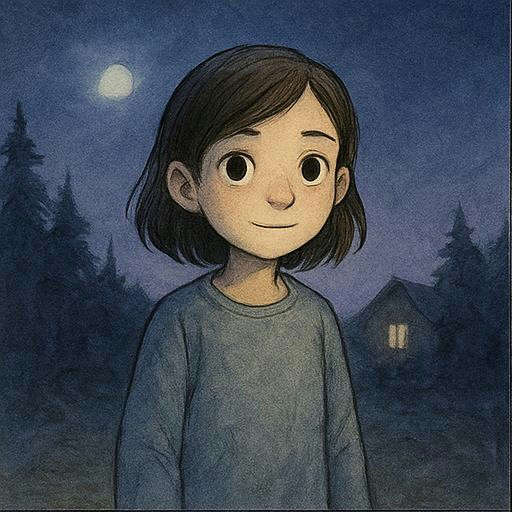
Rivin lay still in her new bedroom, listening to the house breathe around her. The walls were pale cream, the bed was soft and warm, but everything felt unfamiliar—like wearing someone else's shoes. Downstairs, boxes sat in towers. Her parents had fallen asleep hours ago, their snores drifting up the stairwell like distant trains. But Rivin's eyes would not close. The old house ticked and creaked, and each sound made her jump. What was that? The ceiling groaned. What about that? She pulled the quilt higher, watching shadows pool in the corners. When would morning come?
Rivin had never lived in a house this old. Their last apartment was modern and quiet, with smooth walls and steady hums from the refrigerator. This house had a hundred small voices. A door frame clicked. The pipes shuddered. The stairs whispered when no one was on them. She thought about her old room, three towns away, where she'd slept easily. She thought about her friend Mira, now impossibly far. That house had felt like an extension of her own skin. This one felt like a museum—beautiful but untouchable.
Around midnight, Rivin heard something different. Not the creaking of old wood, but a soft, scratching sound. Her heart stuttered. It came from behind the wardrobe in the corner. Rivin sat up slowly, gripping the edge of her quilt. The sound stopped. Then it came again—a gentle, deliberate scratch, followed by a tiny, high-pitched squeak. Not frightening, exactly. Almost... curious? Rivin found herself moving toward the wardrobe, though her legs felt uncertain. She crouched down, her fingers trembling as they touched the cool floor. The scratching continued, patient and determined.
“Hello?” Rivin whispered. Her voice sounded strange in her own ears. The scratching stopped immediately. She waited. A moment later, she heard it again—but this time softer, almost questioning. Rivin pulled back the wardrobe. Behind it was a gap of perhaps three inches, dark and dusty. And in that darkness, she caught a flash of something. An eye. Bright and black and watching her with an intelligence that made her breath catch. “You're stuck,” Rivin said, understanding somehow without being told. The creature—for it was surely a creature—squeaked in agreement.
Rivin pulled the wardrobe away from the wall. It was heavier than she expected, and she had to lean her whole body into it. Her shoulders ached. Her cheeks flushed hot. But slowly, slowly, the wooden cabinet slid across the floor, and the gap grew wider. A small mouse emerged, its fur silver-grey, its tail curled like a question mark. It was not afraid of her. It sat on its haunches and looked at her with an expression that seemed almost grateful. “Welcome to the house,” Rivin whispered. The mouse twitched its whiskers. Rivin could have sworn it smiled.
“Are you hungry?” Rivin asked. Of course it was hungry. The mouse had been trapped behind the wardrobe, perhaps for days. She crept downstairs in her bare feet, careful to miss the third step, which she'd already learned was a squeaker. The kitchen was dark and silver with moonlight. She found a piece of bread in the pantry and broke off a corner, crumbling it onto the table. The mouse climbed onto a chair and ate with delicate, methodical motions. Rivin sat opposite, watching. They didn't speak. They didn't need to. The silence between them felt warm.
“What's your name?” Rivin asked. The mouse paused mid-bite. “You look like a... Thimble.” The mouse twitched its right ear. That, Rivin thought, probably meant yes. She offered Thimble another crumb. “I'm Rivin. I just moved here today. Or yesterday. Time feels strange in this house.” Thimble resumed eating, unbothered by her rambling. Rivin found herself telling the mouse about Mira, about the old apartment, about how she'd wanted to stay awake all night because sleeping made the change feel real. Thimble listened. That was all. Just listened.
By the time they finished, Rivin realized something had shifted. The kitchen no longer felt cold and strange. It felt like theirs—hers and Thimble's. The shadows seemed less sharp. The moonlight seemed less accusatory. Thimble groomed its whiskers with a tiny, efficient paw. “Come on,” Rivin said. “I want to show you something.” She scooped Thimble gently into her cupped hands. The mouse was feather-light, warm, and its heartbeat felt like a second clock ticking against her palm. Together, they left the kitchen. The old house creaked softly, almost in welcome.
Rivin carried Thimble to her bedroom window. The view stunned her in a way the daylight tour hadn't. The backyard was transformed. Silver grass stretched toward a dark garden. Beyond it, the forest began—a wall of black-green shadows under a bruised purple sky. Stars scattered above like salt. Rivin pressed her forehead against the cool glass. “It's beautiful,” she breathed. Thimble squeaked softly in agreement. For the first time since arriving, Rivin felt something other than displacement. She felt awe. The house wasn't trying to scare her. It was trying to show her things.
She returned Thimble to a small cushion near the radiator, warmed and humming gently. Rivin expected to curl back under her quilt and finally sleep. But instead, she found herself wandering the hallway. The house seemed different now—not threatening, but patient. It seemed to be waiting to show her something else. At the far end of the corridor, she noticed a door she hadn't seen before. Or perhaps she had, and her tired, anxious mind had simply refused to see it. It was painted a soft grey-blue, almost the color of dusk.
Rivin's hand hesitated on the doorknob. The wood was warm. She turned it slowly. The door opened without a sound onto a small library she hadn't known existed. Shelves lined every wall, and books filled them—old books with worn spines and cloth covers. But what stopped her breath was this: the window seat. It faced north, overlooking the forest. And on the cushion lay a leather journal, open as if waiting. She stepped inside slowly, drawn forward. Her fingers trembled as she read the inscription on the first page: *This house remembers. What will you remember?*
Below it, in handwriting that shifted and changed with each entry, were memories. Not the family's memories—hers. Rivin's own handwriting appeared in the journal, describing her second night in the house, her fourth, her hundredth. How had this happened? How was she reading her own future? Her mind spun. Then, slowly, the answer came. The house was showing her something she couldn't yet understand: that she would stay. That this place would become home. That the loneliness she felt tonight was only the first page of a much longer story. Rivin sat on the window seat, breathing slowly. The revelation didn't frighten her. It comforted her.
She closed the journal gently and made her way back to her room. Thimble was already asleep on the cushion, curled into a grey-silver comma. Rivin climbed into bed and pulled the quilt to her chin. The house continued its quiet conversation—a creak here, a sigh there. But now she understood: it was talking to itself, not to her. She was simply being allowed to listen. The old floorboards weren't complaining. They were remembering. The pipes weren't protesting. They were breathing. Everything alive in their own patient way.
Rivin's eyes grew heavy. Sleep approached like a tide. She thought of Mira, far away in the old apartment. She thought of the girl she'd been yesterday, rigid with fear. That girl felt very young now. She thought of the library door, the journal, the impossible promise written there. Somewhere in the house, Thimble dreamed. Somewhere downstairs, her parents slept. And Rivin, suspended between the night and the morning, felt something she hadn't expected: she felt held. The house held her. The darkness held her. Tomorrow held her, waiting gently.
Sleep came quietly. In the dream, the house was humming softly—a lullaby that had no words but every meaning. Rivin walked through hallways lined with familiar and unfamiliar things, and both felt equally like home. Behind her, silver bells chimed. Ahead, doors opened onto glimpses of seasons she hadn't lived yet. And in the morning—which came as it always does, unhurried and sure—Rivin would wake to sunlight and the smell of coffee, and she would understand: home isn't a place you arrive at. It's a place that slowly decides to keep you. This house had already decided. And so had Rivin.