
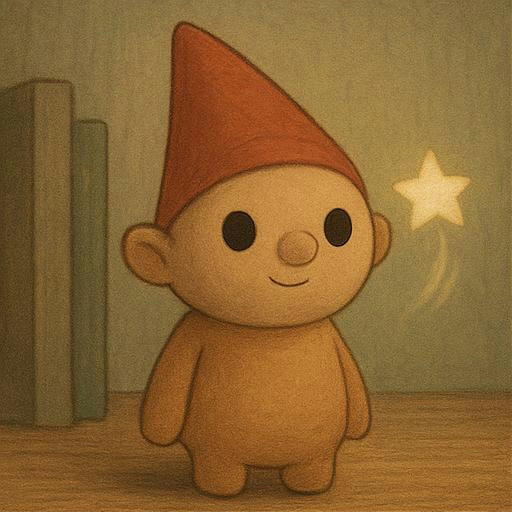

Story Preview
Dobik lived on a shelf. Not a boring shelf — a very good one, with a ceramic mug, three leaning books, a pinecone, and a bunch of dried lavender that smelled of summer-before-last. But Dobik was the only soft thing on it. He sat with his legs dangling over the edge and watched the room the way you watch a window in the rain — hoping for something, not sure what.
The boy who owned the room had gone away for a week. The room was very quiet. Dobik liked quiet, mostly. But this quiet had a particular emptiness to it, like a sentence that stops before the best word. “Seven days,” Dobik said to the pinecone. The pinecone did not reply. It never did. But he appreciated its company anyway.
On the second night, something floated in through the curtain gap. It was the size of a grape. It glimmered silver-lavender, like moonlight had been folded into a crumple. It bumped softly into the mug, then the wall, then drifted sideways and bumped into Dobik's hat. His hat tilted. The little light sneezed — a high, tinkling sound like a pin dropped on a piano key.
“Excuse you,” said Dobik. “Sorry,” said the light. “I'm lost.” Dobik stared. In all his shelf-sitting years, nothing had ever apologized to him before. “Lost from where?” he asked carefully. “From the ceiling of the world,” said the light. “Stars shed sparks sometimes. I got sneezed out during a very large meteor shower. Terribly embarrassing.” Its glow flickered on the last word, and Dobik thought it looked just the tiniest bit sad.
The spark's name, it turned out, was Pip. Pip couldn't go back on its own — a shed spark needs someone to send it home, and sending takes a specific kind of wish. “Any wish will do,” Pip said, drifting a slow loop, “as long as it costs something. Magic always costs something.” Dobik's hat tilted. “Costs something,” he repeated. “What does that mean, exactly?” “It means the wisher gives up something real,” Pip said simply. “Not a pebble. Something that matters.”
That night, Dobik let Pip sleep in the mug. Pip lit up the inside of it with a silver warmth that made the whole shelf shimmer like a snow globe. Dobik sat very still and watched it. He had never had a guest before. It was different from being alone, and the difference was enormous — like the difference between a closed book and an open one.
By the third morning, Pip had begun to teach Dobik games. There was flick-the-beam, where Pip bounced light off the mug in patterns, and Dobik tried to catch the shapes with his felt hands. There was whisper-echo, where you said something very quietly and the other one repeated it back changed, funnier. “Pinecone,” said Dobik. “Prickle-king,” said Pip. Dobik laughed so hard his hat fell forward over his button eyes.
On the fifth day, Dobik noticed something. Pip was dimmer. Not by much — but Dobik had been watching carefully, and the silver-lavender glow had softened, gone flatter at the edges. “You're fading,” Dobik said. “A little,” Pip admitted. “Sparks that stay away from the sky too long... they get smaller. I don't want to worry you.” But Dobik was already worried. He was an excellent worrier.
“Then we have to send you back,” Dobik said. Pip drifted close. “I thought you might say that. But Dobik — I don't want to go. This shelf is the first place I've ever truly landed.” Dobik understood that feeling precisely. It lived in his chest like a small warm stone. “I know,” he said quietly. “I know exactly.” Neither of them spoke for a while. The lavender bunch rustled in the draught from the window.
Here was the problem. The only thing on the shelf that Dobik truly, deeply, always-loved was his hat. Not because it was special to anyone else. But the boy had placed it on Dobik's head on the very first day, pressing it down with one gentle finger. It was the only thing he'd ever been given. And to send a lost spark home, the wisher had to give up something that mattered. Dobik sat very still for a long time.
“Are you thinking what I think you're thinking?” Pip asked. Dobik's hat was standing perfectly straight. “Possibly,” said Dobik. “You don't have to,” Pip said quickly. “I could just... get a little smaller. It's fine, really. I'm very good at fine.” “You're not fine,” Dobik said. “And friends don't pretend to be fine at each other.” Pip flickered. Then it said, very quietly: “Is that what we are?” “Yes,” said Dobik. “Obviously. Pay attention.”
Dobik reached up. His felt fingers closed around the brim of his red hat. He held it for a moment — remembering the finger that had pressed it down, the first day, the beginning of everything. Then he held the hat out over the edge of the shelf, toward the window where the moonlight came in, and he made his wish. Not out loud. Wishes that cost something don't need to be spoken.
The hat dissolved. Not like burning — more like when sugar stirs into warm tea. It thinned, and sparkled, and was gone. And Pip blazed. The whole room turned silver-lavender for one breathtaking second, every shadow lit soft and shimmering, the pinecone glowing, the mug gleaming, the books casting moon-colored light across the floor. Then Pip rose, slow and bright, toward the curtain gap. “Dobik,” Pip said. “Go on,” said Dobik. “The sky is waiting.”
Pip slipped through the curtain. The room went back to ordinary dark. Dobik sat on his shelf with no hat and a head that felt strange and cool and bare. He looked at the mug, and the books, and the pinecone, and the dried lavender. He thought about Pip's laugh — the tinkling pin-on-piano sound — and how he would remember it for always. That was the kind of thought that wasn't sad, exactly. It was something fuller than sad.
The boy came home on the seventh day. He walked straight to the shelf, the way he always did, and he looked at Dobik. He noticed the missing hat immediately. He stood very still for a moment — and then, carefully, he took a small red paper star from his pocket and balanced it on top of Dobik's head. It wasn't a hat. But it caught the light from the window, and it glittered silver-red, and Dobik's button eyes shone. Somewhere above the roof, a tiny spark blazed once, bright as hello.